
Tata Motors has launched the Sierra Legend Series, a new line of its iconic Sierra mid-SUV, designed to democratize premium features across all variants. This strategy, dubbed "Luxury, From The Base," aims to challenge traditional industry norms by offering high-end comfort, refinement, and technology even in entry-level models, ensuring the Sierra remains a benchmark in the competitive Indian automotive market.

Tata Motors Passenger Vehicles (TMPV) is strategically expanding its international footprint by launching the Nexon, rebranded as Osprey, in South Africa, a move set to significantly boost its export volumes and solidify India's position as a major automotive export hub.

Tata Motors Passenger Vehicles Ltd (TMPV) has launched its new brand identity, TATA.CARS, aiming to appeal to a younger demographic with a focus on smarter, greener, and more connected mobility experiences.

Tata Motors expands its market leadership in India's electric passenger vehicle (ePV) segment, capturing 39 per cent of the market in Q1FY27, while simultaneously strengthening its position as the nation's second-largest carmaker amidst fierce competition and rapid market growth.

Tata Motors is set to acquire Italy's Iveco Group, a strategic move aimed at propelling the Indian automaker into the top four global commercial vehicle (CV) manufacturers, with projected annual revenues of $35 billion-$40 billion within five years.

Commercial vehicle manufacturer Tata Motors Ltd reported an impressive 83 per cent increase in consolidated net profit, reaching Rs 2,556 crore for the first quarter ending June 30, primarily boosted by a significant mark-to-market gain on investments in Tata Capital Ltd.

Tata Motors Passenger Vehicles (TMPV) reported Q1FY27 results showing significant margin pressures at both Jaguar Land Rover (JLR) and its domestic operations, despite strong volume growth in the India business. Analysts expect these margin headwinds to persist, potentially offsetting gains from increased sales and new launches.
Tata Motors Passenger Vehicles Ltd (TMPV) announced a price hike of up to Rs 25,000 across its ICE and electric vehicle models, effective September 1, to mitigate rising input costs and inflationary pressures.
Tata Motors emerged as the biggest gainer in the passenger vehicles (PV) market in the second half of FY25, following a GST rate cut in September, achieving the highest growth among major OEMs and overtaking Mahindra & Mahindra in volumes.

Tata Motors' commercial vehicle (CV) business is strategically repositioning itself from a traditional truck manufacturer to a comprehensive logistics and mobility platform, aiming to reduce dependence on cyclical vehicle demand by accelerating growth in digital, international, and services segments.

Commercial vehicles major Tata Motors Ltd has announced a record 144 patent applications filed in FY26, its highest in a single year, focusing on vehicle safety, reliability, cost, comfort, and future mobility solutions like electric and hydrogen vehicles.
Tata Motors' commercial vehicle business is increasingly focusing on parts, services, connected-vehicle platforms, and digital businesses to drive growth and reduce dependence on cyclical vehicle sales, as outlined in its FY26 annual report.
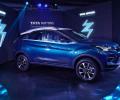
Tata Motors has emerged as the biggest market-share gainer among India's leading passenger vehicle (PV) makers in the first eight months of 2026, securing the No. 2 position in the PV market.

Tata Motors Passenger Vehicles is gearing up for the next phase of electric vehicle adoption in India, targeting over 30% EV penetration by FY31. The company plans to launch four new products and over ten refreshes by FY31, expanding its portfolio to ten EV nameplates. This strategy aims to move beyond early adopters to engage the early and late majority consumers, focusing on enhanced range, faster charging, and improved battery technology.

With its Battery-as-a-Service (BaaS) model Tata Motors just redrew the EV battle lines, says Rajesh Karkera/Rediff.com

Tata Motors' commercial vehicle (CV) business debuted on the BSE on Wednesday, completing the automaker's long-planned demerger into separate listed entities for its passenger and CV operations.

Leading automakers in India, including Maruti Suzuki, Tata Motors, Mahindra & Mahindra, and Hyundai, reported increased vehicle dispatches to dealers in February, driven by sustained domestic demand.
Leading automakers in India, including Maruti Suzuki, Tata Motors, Mahindra & Mahindra, and Hyundai, reported increased vehicle dispatches to dealers in February, driven by sustained domestic demand.

The Curvv hasn't set the sales charts on fire and Tata needs another product aimed straight at the Hyundai Creta, which is where the Sierra fits in.

Tata Motors Passenger Vehicles is the latest to come forward to honour them as the company has decided to present the team members with the soon-to-be-launched Tata Sierra.

Tata Group stocks experienced a significant decline, with TCS falling nearly 6 per cent, after Tata Sons Chairman N Chandrasekaran announced he would not seek reappointment when his current term concludes on February 20, 2027.

Tata Motors Passenger Vehicles Ltd on Tuesday said it delivered over 1 lakh vehicles in 30 days from Navratri to Diwali, a growth of 33 per cent over the same period last year. The deliveries were led by SUVs with electric vehicles also showing strong traction, Tata Motors Passenger Vehicles Ltd managing director and CEO Shailesh Chandra said in a statement.
Moody's Ratings on Monday downgraded Tata Motors' outlook to negative from positive following a cyber attack on its British arm Jaguar Land Rover which has led to a complete production halt. The rating agency affirmed the Mumbai-based auto major's Ba1 corporate family rating (CFR).

At a valuation of around Rs 10 trillion, Tata Sons would rank among India's 10 largest listed companies and could qualify for inclusion in key indices such as the Nifty 50, Sensex and the Nifty 100.
The passenger vehicle (PV) business of Tata Motors, which also includes the electric vehicle and Jaguar Land Rover businesses, post-demerger is now valued at Rs 1.45 trillion.

'... that work is done. The task is to reallocate what has been built, with the courage of a founder and the discipline of an owner.'

Chandra's tenure also saw a big jump in Tata Sons' other income, such as brand fee from group companies, treasury gains, and other non-recurring income.

J R D Tata, chairman of the Tata group from 1938 to 1991, said that whenever he had to make a difficult decision, he would ask himself, what will be good for India, and what will be good for the Tatas. If he had a doubt, he would decide in favour of India. In the long run, it would turn out well for the Tatas too, he said, points out Arun Maira.
At an aggressive starting price of 18.79 lakh, the Tata Sierra.ev has a real-world range of 510 to 530 km with the 75 kWh battery pack on a single charge while the smaller 63 kWh battery coughs out a real-world range of 440 to 460 km, plus lifetime battery warranty as standard. And with the intelligent Quad-Wheel Drive system pushing out 504 Nm of torque, the EV flies from 0 to 100 km/h in just 5.8 seconds, says Rajesh Karkera.

Tata Sons has the balance sheet to support them, for now.
Mahindra and Mahindra (M&M) recorded the sharpest acceleration among large players, with EV retail jumping to 33,513 units from 7,139 units, an almost 5-fold jump, aided by strong demand for new launches.
Tata Motors on Thursday said it has filed 250 patents and 148 design applications, its highest-ever in a single year, in FY25. The filings encompass a broad spectrum of product and process innovations, aligning with key automotive megatrends such as Connectivity, Electrification, Sustainability, and Safety (CESS), as well as emerging technologies like hydrogen-based vehicles and fuel cells, the Mumbai-based auto major said in a statement.

Tata Motors and Mahindra & Mahindra have cut the prices of their SUV models to boost demand. Tata Motors has revised the starting prices of its flagship SUVs, the Harrier (Rs 14.99 lakh) and the Safari (Rs 15.49 lakh) and extended benefits of up to Rs 1.4 lakh on other popular SUV variants.

Tata Motors has officially launched the Tata Sierra #DARK in India, with prices starting from 13.99 Lakh (ex-showroom). This new edition features a Friesian Black exterior, a Violet Eclipse interior, and a range of engine and transmission options across multiple variants.
Tata Motors, which now houses the company's commercial vehicle business, on Thursday reported a consolidated net loss of Rs 867 crore in the September quarter, impacted by mark-to-market losses of Rs 2,026 crore on account of investment in Tata Capital.

Tata Motors on Monday announced the demerger of its commercial and passenger vehicle segments into two separate listed entities to better capitalise on growth opportunities. The commercial vehicles business and its related investments would be housed in one entity while the passenger vehicle business, including electric vehicles, Jaguar Land Rover (JLR) and its related investments, would be part of the second entity, the auto major said in a regulatory filing. Tata Motors chairman N Chandrasekaran said that Tata Motors has scripted a strong turnaround in the last few years.

Why is Shailesh Chandra, managing director of Tata Motors Passenger Vehicles and Tata Passenger Electric Mobility, not worried about the competition?

Maruti Suzuki India and Tata Motors on Monday announced plans to increase vehicle prices from April, the second time in this year, in order to partially offset the impact of rising input costs. Maruti Suzuki said it plans to hike prices of its entire model range by up to 4 per cent from next month.

N Chandrasekaran not only faces muted financial performance from the group's listed companies, but also mounting losses at Tata Sons' unlisted subsidiaries, many of which have been set up by him in the last decade.
'The reported deal between the European Union and China should mitigate it (shortage) for the medium to long term. Let's wait and watch how this plays out.'
